
Britain, France, and Canada: Between Double-Standards and Opportunism

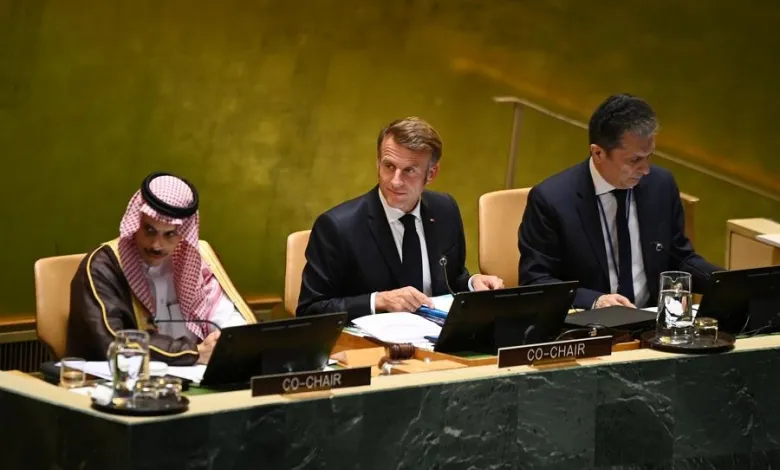
Many applauded as Western countries, including Canada, France, the UK, Spain, Australia, and Portugal, successively recognized the State of Palestine over recent months. This culminated in the International Conference for the Peaceful Settlement of the Question of Palestine and the Implementation of the Two-State Solution, a summit held at UN Headquarters in New York on September 22, 2025. At this event, French President Emmanuel Macron, Saudi Foreign Minister Prince Faisal bin Farhan, and Saudi Minister of State for Foreign Affairs Adel al-Jubeir—in an apparent protocol irregularity in the conference’s chairing—announced the recognition of Palestine and reaffirmed support for a two-state solution based on the pre-5 June 1967 borders.
The reason stated for these governments’ actions by leaders like Macron, UK Prime Minister Keir Starmer, Canada’s Prime Minister Mark Carney, Australia’s Prime Minister Anthony Albanese, Spain’s Prime Minister Pedro Sánchez, and others is a moral duty rooted in history, compelling them to acknowledge Palestinians’ right to their own state. This reason is particularly significant for Keir Starmer, considering that the UK once held the League of Nations Mandate over Palestine and failed to establish a Palestinian state after withdrawing in 1948. This historical obligation continues to burden British policymakers and Western leaders alike, who now aim to correct past omissions by recognizing a Palestinian state today, even if only symbolically.
Following the same sense of ethical responsibility that has stirred their conscience, it would have been more appropriate for the UK to first acknowledge Scotland’s right to self-determination and independence—something they have sought for decades—and also recognize Northern Ireland’s claim, which fought a war for independence but was denied, resulting in British policies that caused Irish bloodshed and lives lost in opposition to their self-determination. The Duchy of Wales also seeks some self-governance that London currently denies. Addressing these issues should have come before recognizing a Palestinian state.
Similarly, Spain could have initially granted Catalonia the right to self-determination and independence. In the 2017 referendum, approximately 91 percent of Catalan voters favored secession and creating a Catalan state; in response, Madrid prosecuted Catalan leaders, exiled some, issued threats, and sentenced others to prison. This also applies to the Basque Country’s independence claims. Based on this logic, Madrid should have recognized the independence of these regions before acknowledging a Palestinian state.
It would also have been more appropriate for Macron to grant Corsica, New Caledonia, and France’s overseas territories—areas controlled by France for over a century—the right to self-determination and the option to form their own states before recognizing a Palestinian state.
Regarding Canada, it might have been preferable to allow French-speaking Quebec, which advocated for secession since the 1960s, its right to independence and statehood before Ottawa acknowledged Palestine.
If the historical responsibility for the absence of a Palestinian state has troubled Western leaders, shouldn’t they also feel responsible for the absence of a nation uniting the Amazigh people across North Africa? The Amazigh make up approximately 60% of the population in Algeria, Morocco, Mali, Niger, and other countries. This same historical duty also calls on France, which divided the Amazigh when drawing borders during colonial times, to support a state that unites the Amazigh and addresses their dispersion, possibly through an international conference ensuring their right to self-determination. The injustice deepened when, in 2012, Amazigh leaders declared the State of Azawad in northern Mali, including Gao, Kidal, and Timbuktu. France responded with Operation Barkhane, military action to suppress the Amazigh and dismantle that state, despite its supposed historical conscience.
Why then do Britain and France turn a blind eye to their own historical responsibilities when it comes to the Kurds? They partitioned an entire nation, Kurdistan, among Iran, Turkey, Iraq, and Syria through the Sykes-Picot Agreement of 1916, yet they remain silent on endorsing the right of 50 million Kurds to self-determination and the creation of their own homeland. Why does the urgent call for a two-state solution in Israel and Palestine resonate deeply in Paris and London, while the Kurdish plight, marked by a century of unimaginable suffering, displacement, and calamity, remains empty of the same empathetic weight? Why do they ignore this enduring human tragedy that calls for justice and recognition?
And why does Britain also hold back from supporting a settlement for the Baloch people (approximately 10 million), whom it split between Iran and Pakistan during its control over India and Iran last century?
Consider this: if the Amazigh, Kurds, and Baloch had accumulated hundreds of billions of dollars, would France, Britain, and other European nations not rush to convene international conferences to support their self-determination and the creation of their own states? The sheer magnitude of wealth could have tipped the scales. Yet, instead of principles, hypocrisy and opportunism reign. Leaders like Macron, Starmer, Sánchez, and Carney now endorse Palestinian self-determination, caving to the pressures of Saudi Arabia, Qatar, and the UAE, nations that Paris, London, and Madrid now solicit, although having once been the architects of those very states just decades ago. This stark contradiction exposes the true motives behind their stance, revealing a sordid dance of double standards that prioritizes geopolitical interests over justice.
The economic and financial crises affecting France, Britain, and Europe have led Macron, Starmer, and Sánchez to seek favor from Gulf monarchies. This has reinforced double standards in both foreign and domestic policy, as they focus on a single cause while ignoring others of a similar nature.
*The views expressed in this article are those of the author and do not necessarily reflect the positions or policies of the research center.