
Official Delegation from the Embassy of the People’s Republic of China in Lebanon Visits ICGER: Agreement to Explore Avenues for Cooperation

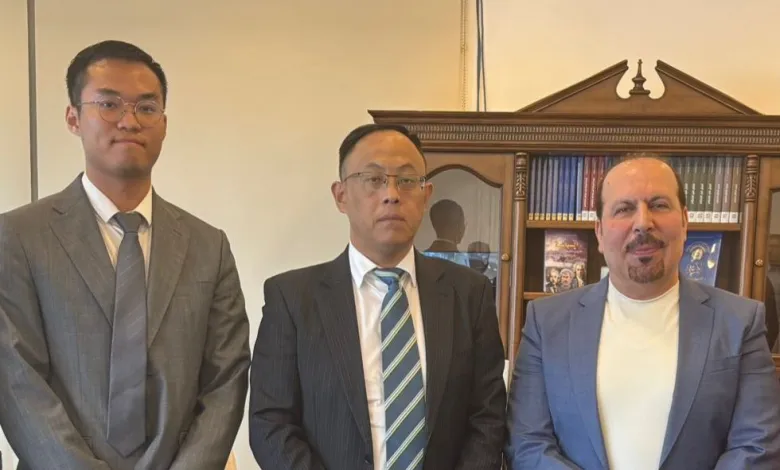
An official delegation from the Embassy of the People’s Republic of China in Lebanon, led by Mr. Wu Shutao, Head of the Embassy’s Political Section, visited the International Center for Geopolitical & Economic Research and Artificial Intelligence (ICGER) in downtown Beirut on Wednesday, September 24, 2025.
ICGER President Dr. Mohammad Walid Youssef welcomed the delegation, with department heads and staff in attendance. He detailed his perspective on political science and introduced the Center’s artificial intelligence initiative aimed at predicting political developments to help prevent crises.
The discussion focused on strategic files concerning China and the upcoming challenges it could encounter, especially in Central Asia and the Middle East. It also examined potential hurdles to the Belt and Road Initiative amidst ongoing geopolitical shifts. Additionally, the meeting highlighted new regional developments, such as the Pakistani–Saudi alignment and Pakistan’s role—as a Sunni nuclear state—in the Middle East’s power dynamics.
Both sides talked about efforts to combat groups labeled as terrorist organizations. Dr. Youssef introduced ICGER’s comprehensive strategy to reduce the global risks from these groups and to support the protection of states and societies from their dangers.
At the end of the visit, both parties agreed to maintain open communication and enhance cooperation through reciprocal visits between ICGER and China’s representatives. The delegation gave Dr. Youssef an artistic souvenir representing Chinese heritage. In return, Dr. Youssef presented the delegation with copies of his works, including his six-volume series in Arabic, “Toward the Rationalization of History,” and his recent books “Politics: Newtonian Classical Rules and Quantum Principles” and “Ashʿarism, Society, and the State.”
The delegation toured ICGER’s facilities, met with department heads and geopolitical unit leaders, and then attended a luncheon in their honor hosted by Dr. Youssef.


