
Europe and Russia on the Brink of a Nuclear War: The Unfolding of a Previously Outlined Scenario

The assessment of Dr. Mohammed Walid Youssef in “Russia, Europe, and the Coming Nuclear War” (published on March 25, 2024) highlighted the recent escalation in nuclear preparations and European military threats in anticipation of any direct clash between Russia and its ally Belarus on one side, and Europe and the NATO alliance on the other. Dr. Youssef mentioned Russia’s probable combined land, air, and sea assault on Ukraine by the end of spring or the beginning of summer 2024 using conventional weapons. He pointed out that regardless of the outcome of this assault, “Russia and the West are on the brink of a nuclear war in Ukraine, inevitably…” He also noted the possibility of “the entry of NATO forces into Ukraine in some key axes, which are suspected of being the Russian attack routes, such as Odesa, along the Dnieper River, or near the Belarusian borders.”.
Nuclear Preparations
At the nuclear level, the Russian Ministry of Defense announced that President Vladimir Putin has ordered the commencement of preparations for military exercises involving the use of non-strategic (tactical) nuclear weapons. The ministry stated: “Based on the instructions of the Supreme Commander of the Russian Armed Forces, and in order to increase the readiness of non-strategic nuclear forces to carry out combat missions, the General Staff has begun preparations to conduct an exercise with missile formations of the Southern Military District, involving the participation of aviation as well as naval forces.”i
The statement added that during the exercise, “a series of activities will be carried out to train in the preparation and use of non-strategic nuclear weapons.” It noted that the exercise aims to “maintain the readiness of personnel and equipment of units involved in the combat use of non-strategic nuclear weapons, in order to respond and ensure the safety and sovereignty of Russian territory without any condition in response to provocative statements and threats issued by some Western officials against Russia.”
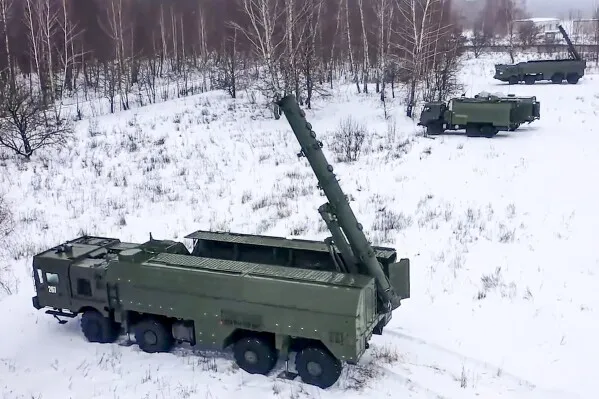
Simultaneously, Belarus, Russia’s ally, announced that the Belarusian army had begun maneuvers to assess the readiness of tactical nuclear weapons launchers.
Belarusian Defense Minister Lieutenant General Viktor Khrenin said on Tuesday that President Aleksandr Lukashenko had ordered a sudden inspection of military units capable of using tactical nuclear arms and other forces.
Khrenin said “A unit of Iskander operational-tactical system and a squadron of Su-25 aircraft are being prepared to carry out their intended tasks.
He said that testing would be undertaken on “An entire range of processes including planning, preparation, and use of non-strategic nuclear weapons.”ii
Mutual Threats
On the military threat level, French President Emmanuel Macron reaffirmed he did not rule out sending troops to Ukraine, saying the issue would “legitimately” arise if Russia broke through Ukrainian front lines and Kyiv made such a request, in an interview with the Economist published Thursday. He added, “Excluding it from now means that we have not learned the lessons of the past two years when NATO countries initially ruled out sending tanks and planes to Ukraine after the Russian attack on Ukraine in February 2022 before changing their minds.”iii
Meanwhile, Belarusian President Alexander Lukashenko said the risk of military incidents on the Belarus-Ukraine border is quite high. The President also said there could be an ‘apocalypse’ if Russia used nuclear weapons in retaliation for Western actions.iv
He also emphasized that tactical nuclear weapons are deterrent and defensive weapons and will not be used in an attack, pointing out that “expanding military blocs and alliances at the expense of the security of other countries, as well as the unprecedented buildup of NATO capabilities in our region, exacerbates the situation.”
He added, “We will not succumb to provocations nor fight anyone. Our mission is that if the enemy sets foot on our land again, we must inflict significant damage on their forces.”
Dr. Youssef’s Scenario
In confirmation of Macron’s warnings about “crossing the front lines,” Dr. Youssef had outlined a complete scenario of the conflict, which seems to be on the verge of realization. He mentioned in his study that Putin would announce a comprehensive attack on several axes:
– Zaporizhia – Mykolaiv – Odessa axis: to control this axis and deprive Ukraine of its most important and largest ports on the Black Sea (Odessa port), to prevent it from exporting its agricultural products and others, and to prevent military imports to it from the sea. Also, to connect Russian territories to the separatist Transnistria province in Moldova by land through southern Ukraine to re-engineer political geography and the theater of strategic operations in the Black Sea, with Russia becoming the largest overseeing state and approaching the eastern wing of NATO by approaching Romania and Bulgaria.
– Kharkiv axis: to control the largest city in northeastern Ukraine, where it is strategically difficult to defend it from the Ukrainian army due to its proximity to the Russian borders, and controlling it opens the way for advancing from it to the capital Kyiv and besieging it from the east.
– Sumy – Kyiv axis: to besiege the capital from the northeast and east, and Russian forces in this axis will advance from Belarusian territories and also from the direct northern axis from the Belarusian borders.
– Donetsk – Dnipro axis, deep into Ukraine by crossing the Dnipro River.
Dr. Youssef added that “the ground assault will last between the summer and the autumn of 2024. If the assault achieves its objectives with conventional weapons and Russia triumphs on the battlefield, or if it imposes peace or surrender on the Ukrainian leadership, President Putin will have tranquility and peace of mind. Otherwise, his last resort will be using tactical nuclear weapons to destroy centers of power, control, command, communication, military intelligence headquarters, and the residence of Ukrainian President Zelensky, aiming to kill him and create a constitutional and political vacuum in the country. It would also target government buildings, parliament, ministries, and civilian institutions.”
He continued, “The West will work to contain the comprehensive traditional Russian ground assault, thwart the preceding aerial campaign, absorb the assault, diminish its intensity, and tame its ferocity. This is aimed at halting the Russian assault in its initial phase, then pushing Ukraine to launch a comprehensive counterattack on specific axes along the front lines.”
He pointed out that “as the attack intensifies and Russia approaches military victory, NATO will use a strategic plan to prevent such a triumph, containing the assault and thwarting it.”
He explained that “The Russian-Ukrainian conflict in 2024 and 2025 will necessarily have one of two factors:
- First: the entry of NATO forces into Ukraine before the upcoming Russian attack. There have been discussions about deploying French, Polish, Estonian, Lithuanian, and Latvian troops in critical areas anticipated to be targeted by the Russian assault, such as Odesa, along the Dnieper River, or near the Belarusian borders. This would escalate the conflict to a Russian-NATO confrontation.
- Second: After containing the comprehensive Russian attack, President Putin will have no choice but to resort to the use of tactical nuclear weapons to prevent the defeat that would befall the Russian army. This would happen at the onset of the extensive Ukrainian counterattack after the dispersion of frustration, despair, and weakened morale within the Russian army following the containment of its assault. At that point, NATO will respond with comprehensive and tactical nuclear strikes on Russian forces in Crimea, destroying the Black Sea Fleet in locations like Luhansk, Donetsk, Mariupol, and others, aiming to prevent a nuclear precedent. Whenever a nuclear state desires to alter international borders or engage in geopolitical re-engineering, it resorts to its nuclear arsenal and achieves its objectives.”
He concluded that “In both scenarios, Russia and the West are on the brink of a nuclear war in Ukraine, inevitable after the failure of the wide-scale Russian attack in the summer of 2024.”
ii https://www.kyivpost.com/post/32272