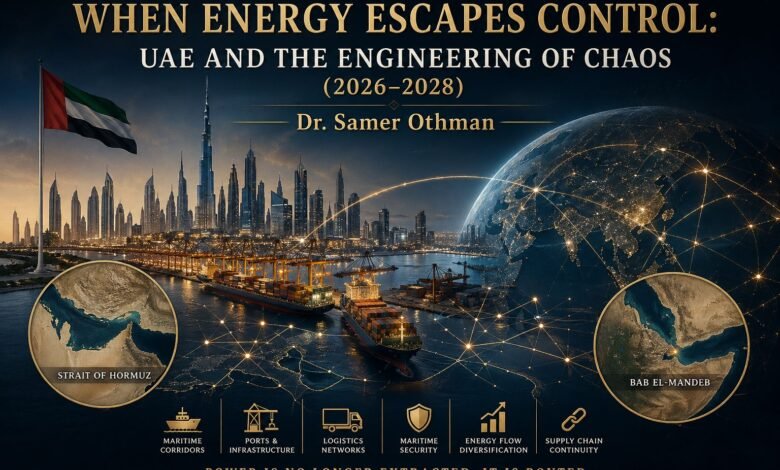
When Energy Escapes Control: UAE and the Engineering of Chaos (2026–2028)

By non-resident colleague Dr. Eng. Samer Othman
Dr. Eng. Samer Othman is an academic and international multidisciplinary expert with a PhD in engineering related to organic systems and sustainable applications. He possesses extensive professional experience as an internationally accredited inspector for the European Union in the field of organic products and quality systems, including ISO and Global GAP standards, where he has contributed to the evaluation and development of production chains according to the highest international standards.
In addition to his technical career, Dr. Othman is a lecturer and expert in political economy and geopolitical relations, with a research focus on the intersection of economics with international power balances and the transformations of the global order. His work combines rigorous engineering analysis with strategic economic vision, enabling him to take a multidimensional approach to complex international issues.
His research interests center on power dynamics in the international system, the limits of contemporary imperial influence, and the impact of protracted wars on the economic and political structures of major powers.
Abstract
This paper examines the strategic repositioning of the United Arab Emirates within Phase III (2026–2028) of the Managed Chaos Reconfiguration Theory (MCRT). It argues that the UAE is not adapting to instability, but operating within it as a functional node in a transforming system. Moving beyond oil-based influence, it redefines power through control of flows—logistics, maritime corridors, and supply chains. This reflects the transition from dispersed instability to structured power fusion.
Introduction
The dominant analytical mistake in reading the Middle East today is to interpret instability as disorder. What appears as fragmentation is, in fact, a transitional structure.
Within this context, the UAE does not react to crisis—it positions itself inside it. This distinction is central. Under MCRT Phase III (2026–2028), power no longer emerges from stability, but from the ability to operate within instability without being consumed by it.
The UAE is not attempting to control the system.
It is embedding itself into its movement.
From Oil Power to Flow Power
For decades, influence was defined through production and frameworks like OPEC. Power meant regulating supply.
That model is structurally declining.
The UAE recognized this early. Its strategy is no longer based on maximizing oil leverage, but on positioning itself within global movement:
- Ports and maritime infrastructure
- Logistics networks
- Supply chains
- Energy transport diversification
Power is no longer extracted.
It is routed.
Maritime Space as a Political Field
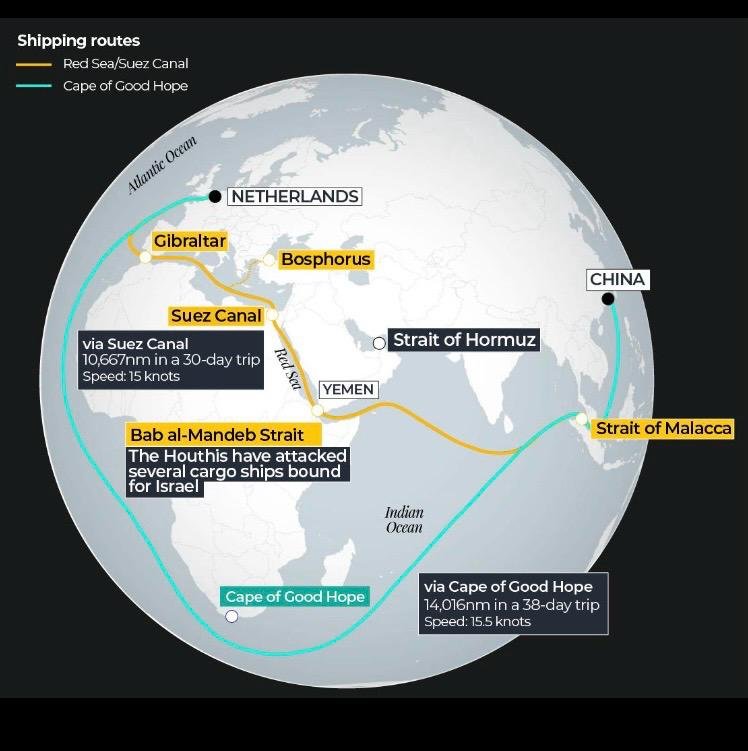
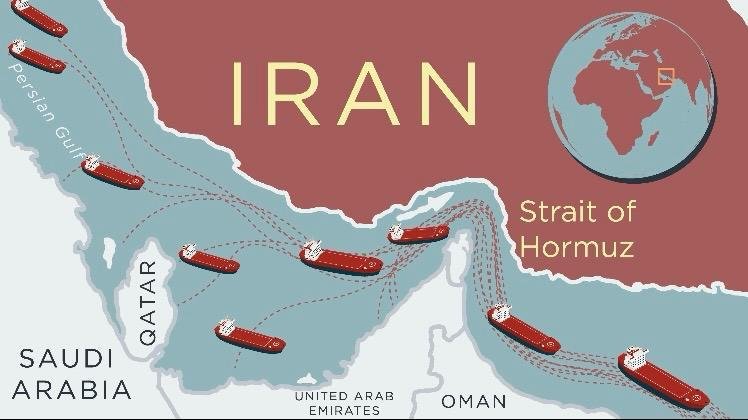
Chokepoints such as the Strait of Hormuz and Bab el-Mandeb are not static locations, but pressure fields. Control is not territorial—it is relational.
The UAE does not need to dominate.
It needs to position itself within flow dynamics:
- Proximity to routes
- Influence over ports
- Integration into security systems
- Continuity under disruption
This is not classical control.
It is control through participation.
Phase III: Power Fusion (2026–2028)
Within MCRT, Phase III marks a shift:
- Fragmentation → consolidation
- Pressure → structure
- Chaos → functional order
The UAE fits this precisely.
It is not a hegemon.
It is a node.
And in a system defined by movement, nodes matter more than centers.
Operating Inside Chaos
The UAE made a decisive move:
Not resisting chaos.
But operating inside it.
While others seek stability, the UAE assumes instability as the environment and builds accordingly:
- Flexible alliances
- Economic positioning
- Infrastructure over territory
The result is not dominance.
It is relevance.
Theoretical Foundation
This aligns with the framework of Mohamad W. Yousef, where political space is a field governed by forces and interaction.
MCRT extends this into a regional model.
The UAE is one of its clearest expressions.
See Maps Appendix for spatial reference of key maritime chokepoints.
Conclusion
The UAE is not escaping chaos.
It is engineering its position within it.
In Phase III (2026–2028), power will not belong to those who control territory or produce resources.
It will belong to those who understand movement.
And position themselves accordingly.
Maps Appendix
Strait of Hormuz
⸻
Bab el-Mandeb