
When Maps Die: Managed Chaos and the Reconfiguration of the Middle East (2023-2028)

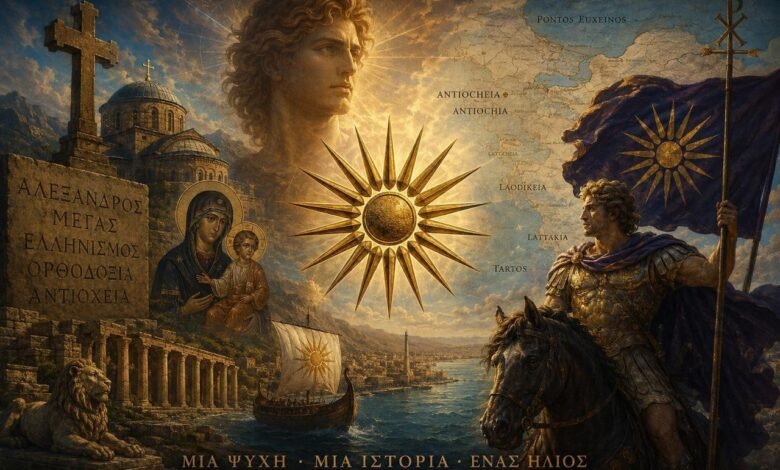

By non-resident colleague Dr. Eng. Samer Othman
In cooperation with Ethnikos Association of Latakia–Antaradus

Dr. Eng. Samer Othman is an academic and international multidisciplinary expert with a PhD in engineering related to organic systems and sustainable applications. He possesses extensive professional experience as an internationally accredited inspector for the European Union in the field of organic products and quality systems, including ISO and Global GAP standards, where he has contributed to the evaluation and development of production chains according to the highest international standards.
In addition to his technical career, Dr. Othman is a lecturer and expert in political economy and geopolitical relations, with a research focus on the intersection of economics with international power balances and the transformations of the global order. His work combines rigorous engineering analysis with strategic economic vision, enabling him to take a multidimensional approach to complex international issues.
His research interests center on power dynamics in the international system, the limits of contemporary imperial influence, and the impact of protracted wars on the economic and political structures of major powers.
When Maps Die:
Managed Chaos and the Reconfiguration of the Middle East (2023-2028)
Strategic Research and Supervision: Dr. Eng. Samer Othman، Founder of MCRT Theory
In Intellectual and Research Partnership With Ethnikos Association of Latakia-Antaradus
Preface
This study constitutes the third research work within the strategic series of the MCRT which seeks to provide a new framework for understanding the structural transformations, reshaping the Middle East in the post-Sykes-Picot era.
Previous studies focused on:
- Deconstructing the concept of “chaos” as an instrument for regional reengineering.
- Analyzing the transition of power centres from the traditional nation-state toward transnational functional networks.
- Examining the relationship between geopolitics, energy systems, and maritime corridors within the emerging global order.
This study specifically focuses on the geopolitical reconfigurations of the Syrian-Antiochian coast within the new Eastern Mediterranean structure, and on the resurgence of coastal-Mediterranean identities as part of the region’s wider transformation.
However, this study does not emerge from an immediate political reading. Rather, it is rooted in deeper historical and civilizational layers, that remained suppressed for centuries beneath centralized political systems established-after the Islamic conquests and later reproduced through the modern nation-state.
Introduction
Since 7 October, 2023, the Middle East has entered a structural transformation extending beyond conventional wars and temporary conflicts. The region has evolved into a comprehensive geopolitical reconfiguration affecting borders, identities, political functions, and economic structures across the region.
Within this context, the MCRT proposes an alternative framework for understanding current events. The theory establishes that the ongoing instability is not a random collapse, but rather a managed strategic engineering process designed to distribute power and define the political and functional geography of the Middle East in a new regional order.
The current chaos brings back to the surface, civilizational layers that had long been surpassed, frozen and buried.
The Syrian Coast and the Transformation of Mediterranean Identity
Within this structural transformation, the Syrian – Antiochain coast emerges as one of the most significant regions likely to undergo geopolitical redefinition in the post-Sykes-Picot era.
The region stretching from Antioch, Alexandretta, Latakia to Tartus represents more than a conventional coastal strip attached to a centralized state structure. It constitutes a distinct Mediterranean sphere of civilization, geographically, and culturally connected to the Eastern Mediterranean more than the ideological and desert-entered political structures of the Mashreq.
Historical sources and Western travel accounts reveal the persistence of distinct, Mediterranean cultural characteristics along the Syrian coast for centuries.
Al-Baladhuri, in Futah al-Buldan, noted that Antioch and Latakia were among the last cities to resist the Islamic expansion, reflecting the coast’s distinct political and civilizational character compared to the inland Mashreq.
The medieval traveller, Burchard of Mount Sion, described parts of the coast as having “thirty Christians for every one Muslim,” indicating the clear majority and ratio of a strong Christian-Mediterranean demographic presence for centuries.
The writings of Henry Harris Jessup and various Western travellers, also point to the social and cultural character of the coastal population compared to inland Syria. While classical references by Pliny the Elder describe the coastal groups of possessing distinctive traits, some of which are believed to have later merged into the social structure of the Alawite community.
In recent years, intellectual currents and cultural-rights organizations have emerged seeking to revive the historical coastal identity of this region as an independent Mediterranean civilizational sphere. Among the most prominent of these institutions is the Ethnikos Association of Latakia-Antaradus, which works toward reviving, exploring and acknowledging the Alawite and Greek Orthodox (Rum) community as an indigenous population, with deep-rooted historical presence for over two centuries.
The Coast as a Refuge for Identities Outside the Center
Historically, the Syrian coast functioned and served as a refuge and safe-haven for identities, and communities existing outside the dominant ideological and political structures.
Historical and ethnographic studies, including the works of Jacques Weulersse and Medieval Rural Settlements of the Syrian Coastal Region- indicate that the coastal mountains became home to a broad spectrum of communities and sects subjected to marginalization, or persecution by central authorities and mainstream Islamic currents.
The coast evolved into what can be described as a “hidden civilizational reservoir”, for Mediterranean-Levantine identities that were never fully integrated into the ideological centralism after the 7th century.
From this perspective, the continuity of the Alawite and Orthodox coastal structure should be understood as a historical continuation of civilization that preserved a degree of cultural and social independence despite centuries of isolation and conflict.
The Assad Era: Distorting Coastal Identity (Transforming it into an Instrument of Power)
The eras of Hafez al-Assad and Bashar al-Assad, represented one of the most consequential and damaging periods for the historical identity of the Alawite community and the Syrian coast in general.
Although the regime relied heavily upon the Alawite social structure to consolidate power, its project was never intended to revive or protect authentic Alawite historical identity. Instead, it functioned as an authoritarian system that reshaped and emptied this identity of its historical and cultural content, before integrating it into a nationalist-military-Islamized-Arabized political structure, designed to ensure regime survival.
The Alawite community was gradually uprooted and covered with the blanket of Arabism-Islamized ideological projects tied to regional conflicts that do not reflect its historical interests or cultural identity.
Rather than transforming the coast into a center of Mediterranean development, progress, the regime converted it into a human-security reservoir serving the survival or the ruling system.
This process manifested through:
- Systematic militarization of society.
- Marginalization of genuine economic development.
- Structural poverty and economic dependence on the security state.
- Permanent use of sectarian fear as a mechanism for reproducing political loyalty.
At the same time, the regime actively surpassed any independent expression of authentic Alawite identity- whether cultural or religious, because any autonomous consciousness was perceived as a potential threat to centralized authority.
In this sense, the Alawite community was not a true partner in power, but a hostage within a system that utilized its demographic as a mechanism for political survival.
Over time, this model produced a profound contradiction between the coast’s authentic historical identity, and the functional role imposed on the Alawite community by the security state.
Instead of protecting the coastal-Mediterranean identity, the regime distorted it and forcibly tied it to the authoritative military and regional projects that ultimately exhausted the coastal population, economically, demographically and civilizationally.
Within the Middle East entering the phase of structural fragmentation after 2023, these contradictions have begun to erupt again, bringing questions concerning the historical identity of the coast, its relationship with the Eastern Mediterranean, and its place within the emerging order back to the forefront.
Buried Identities and Political Reconfiguration
The renewed rise of coastal-Mediterranean identities cannot be understood as an ethnic or cultural phenomenon. It must be interpreted within the wider transformation taking place across the Middle East following the decline of a centralized, nationalist model that dominated the 20th century.
As the region transitions from the era of the ideological state, toward the area of functionality, historically surpassed identities are returning to the surface. Not as nostalgia from the past, but as a reality, and positioning tools within the emerging regional order.
Among these identities are:
- The Kurdish.
- Druze.
- Assyrian.
- Armenian.
- Maronite.
- Phoenician.
And the Alawite and Greek, Mediterranean coastal identity extending from Latakia, Tartous to Antioch and Alexandretta.
In this context, chaos is no longer a condition of security collapse. It is a mechanism in which history that has been buried, civilizational lawyers within the Mashreq rediscovered and reintegrate into the equations of modern power and geopolitics.
The Coast as a Geopolitical Node in the Eastern Mediterranean
According to MCRT, the future importance of the Syrian coast does not stem solely from ethnic or historical dimensions, but from its strategic position within the emerging Eastern Mediterranean order.
The region directly intersects with:
- Maritime energy corridors,
- Eastern Mediterranean gas projects,
- Strategic ports,
- Global maritime trade networks,
- And logistical corridors linking Europe, the Levant, and the Gulf.
Therefore, the redefinition of the coast is not merely a local phenomenon, but part of the broader geopolitical restructuring of the Mediterranean itself.
Within this framework, the intellectual, cultural, and rights-based initiatives led by institutions such as the
Ethnikos Association of Latakia-Antaradus
should be understood as early indicators of this transformation rather than isolated cultural activities detached from regional dynamics.
Phases of the Managed Chaos Reconfiguration Theory (MCRT)
Phase I:
October 7, 2023 – December 8, 2024
This phase represents the detonation of the old regional structure and the collapse of traditional balances through open wars, security breakdowns, and the reshuffling of alliances across Palestine, Lebanon, Syria, and Iraq.
Phase II:
December 8, 2024 – The Beginning of the Major Iranian War
This phase represents the transition from direct military chaos toward regional repositioning, during which international and regional actors begin redrawing spheres of influence, energy corridors, and economic balances.
Phase III:
February 28, 2026 – 2028
This phase represents the reconstruction of the new Middle East according to a model based on:
- Functional entities,
- Political decentralization,
- Transnational economic networks,
- The resurgence of historical local identities,
- And the integration of geopolitics with global systems of energy, technology, and trade.
Within this phase, the Eastern Mediterranean emerges as one of the world’s most important centers for the reconfiguration of global power, accompanied by the growing strategic role of coasts, ports, and energy corridors.
MCRT and the Transformation of the Middle East into a Functional System
The theory argues that the Middle East is gradually evolving toward a new model based on:
- Functional entities,
- Flexible spheres of influence,
- Historical local identities,
- And economic-security hubs integrated into international networks of energy, technology, and trade.
Consequently, the future of the region may not be built upon reproducing traditional centralized states, but rather upon redistributing political and geographical functions within a more complex and decentralized structure.
In this sense, the Syrian–Mediterranean coast may evolve during the coming years into one of the most significant applied models of post–Sykes-Picot transformation within the broader restructuring of the Middle East.
Conclusion
What is unfolding in the Middle East today is not a series of disconnected wars, but a historic transition from an old regional order toward a new system currently taking shape.
At the center of this transformation, historical Mediterranean identities are reemerging as part of a wider redefinition of power, geography, and sovereignty across the region.
From this perspective, studying coastal–Mediterranean transformations and the rise of related political narratives is no longer simply a cultural or ethnic matter, but a strategic necessity for understanding the future of the Middle East itself in the decades ahead.
What chaos is reviving today is not merely the emergence of new borders, but the return of entire buried civilizational layers that remained suppressed for centuries beneath centralized systems of domination before reemerging to reclaim their place within the new Eastern Mediterranean order.
This article reflects the views of its author only and does not necessarily reflect the views of its publisher.