
Netanyahu’s Announcement Confirms Dr. Youssef’s 2026 Forecast: A New Alliance Against “Radical Axes”

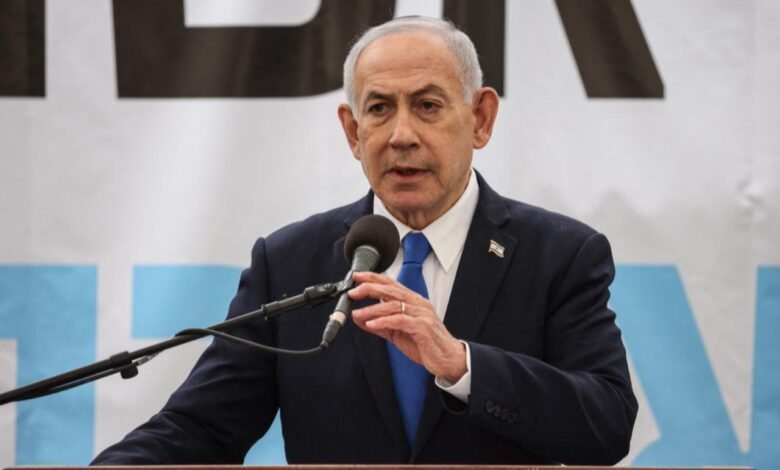
On February 22, 2026, Israeli Prime Minister Benjamin Netanyahu announced Israel’s efforts to forge alliances within or around the Middle East, involving countries like India, Greece, Cyprus, as well as other Arab, African, and Asian nations, to counteract “radical” Islamic factions, both Sunni and Shiite. This policy aligns with Dr. Mohammad Walid Youssef’s analysis in the 2025 Annual Geopolitical Report, where he highlights the rise of two opposing regional blocs. The first bloc hinges on a Saudi–Pakistani alliance, later augmented by Turkey, Egypt, and the Syrian government. The second bloc comprises Israel, Greece, Cyprus, the UAE, India, and similar states actively opposing hardline Islamist organizations.
Netanyahu stated that Prime Minister Narendra Modi’s planned visit to Israel on Wednesday, February 25, 2026, is a significant move to strengthen bilateral relations and broaden Israel’s regional alliances. He described the visit as part of a broader vision to create a network of alliances around or within the Middle East, including countries like India, Arab nations, African nations, Greece, Cyprus, and other Asian nations.[i]
Netanyahu also stressed that “[t]he intention here is to create an axis of nations that see eye-to-eye on the reality, challenges, and goals against the radical axes, both the radical Shia axis, which we have struck very hard, and the emerging radical Sunni axis.”
In a September 22, 2025 article titled “Israel: Between Conventional Iranian Missiles and the Saudi-Pakistani Nuclear Threat,” Dr. Youssef explained that “one effect of the Saudi–Pakistani alliance is the recognition of the Israeli–Indian strategic partnership, initially established in 2015 with the rise of the Hindu Bharatiya Janata Party, that has since strengthened in technology, security, and economic ties. India’s opposition to Islamist groups also brings it closer to Israel, which has faced conflicts with Hezbollah, Hamas, Islamic Jihad, Ansar Allah (the Houthis) in Yemen, and other Islamist factions in the region.”
He remarked: “Similar to how Jerusalem and the Palestinian cause are key issues for Arabs and Muslims in the Middle East, Kashmir is ‘Pakistan’s Jerusalem.’ This highlights the rise of two opposing alliances: one made up of Islamic states, and another consisting of Israel, India, and nations opposing hardline Islamist groups, including Myanmar, the Philippines, and others.”
In a study published on December 31, 2025, titled “Al-Mukalla Incident and the Saudi–Emirati Conflict,” Dr. Youssef stated that “generally, the UAE and Saudi Arabia will diverge on Middle East issues. The UAE tends to support the new alliance in the Eastern Mediterranean formed in December 2025 among Israel, Cyprus, and Greece, while Saudi Arabia prefers cooperation with Qatar, Turkey, and Egypt on issues such as Gaza, Lebanon, Sudan, and others.”
In the 2025 Annual Geopolitical Report on the Middle East and North Africa, published on January 15, 2026, Dr. Youssef highlighted that the key development in 2026 will be the intensifying rivalry between two emerging regional axes. The first comprises Saudi Arabia, Pakistan, Turkey, Egypt, and Qatar, with Syria possibly joining by year’s end. The second is based on the Israeli–Cypriot–Greek alliance formed in December 2025, later expanding to include the United Arab Emirates, Somaliland, and Ethiopia. This rivalry is expected to have significant political, strategic, and economic repercussions.
[i] https://www.gov.il/en/pages/pm-netanyahu-s-remarks-at-the-start-of-today-s-government-meeting-22-feb-2026