
Iran Strikes the Gulf as a Second Round of War on Tehran Begins, as First Outlined in October 2023 by ICGER President

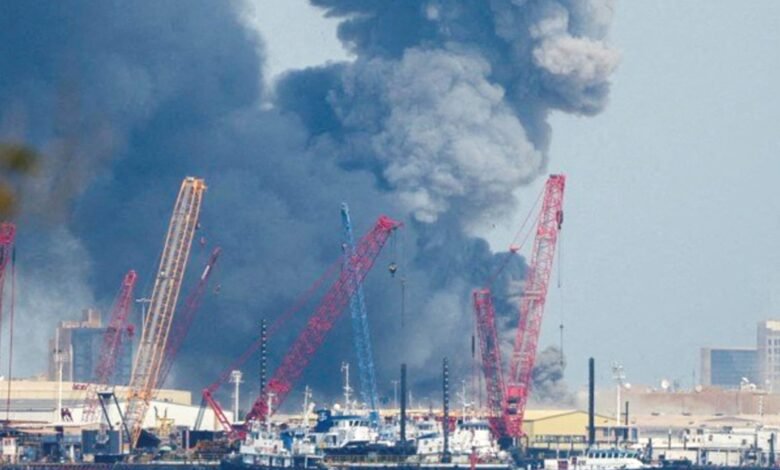
The second phase of the U.S.–Israeli conflict against Iran started on Saturday morning, 28 February 2026, prompting Iran to retaliate by launching missile attacks on Israel and several Gulf nations. These attacks targeted U.S. military installations, particularly in Bahrain, Qatar, the United Arab Emirates, and Kuwait. This situation aligns with the forecast made by Dr. Mohammad Walid Youssef, President of ICGER, since October 2023. He predicted that Iran would target U.S. bases in Gulf countries if the spread of Operation “Al-Aqsa Flood” extended beyond Gaza and involved the broader Middle East.
He also anticipated another escalation in the U.S.–Israeli conflict with Iran following the initial confrontation in June 2025. On July 4, 2025, he remarked that there will be one or two further rounds of war between Iran and Israel in the coming months of 2025, extending into early 2026.
On February 28, 2026, the United States and Israel initiated a substantial joint assault on Iran. Reports detailed explosions in Tehran as well as in several other cities, such as Qom, Isfahan, Kermanshah, and Karaj.
U.S. President Donald Trump announced the start of an attack on Iran, saying: “A short time ago, the United States military began major combat operations in Iran,” while Israel’s Ministry of Defense said Israel had carried out a preemptive strike on Iran.[i]
For its part, Islamic Revolutionary Guard Corps (IRGC) announced the launch of Operation “True Promise 4” in response to “the American–Israeli aggression against Iran.” The Iranian news agency Fars News Agency reported that four major U.S. bases in Qatar, Kuwait, Bahrain, and the UAE came under intense missile attack by the IRGC.
Bahrain’s National Communication Center reported that the service center affiliated with the (U.S.) Fifth Fleet was hit by a missile attack. The UAE’s Ministry of Defense announced that “UAE’s defence ministry said in a statement that the country endured strikes by Iranian ballistic missiles, many of which were intercepted by their air defences.” [ii]
Meanwhile, Qatar’s Ministry of Defense said it successfully intercepted a number of attacks that targeted the state’s territory. In an official statement, the Kuwaiti Cabinet asserted Kuwait’s full and inherent right to self-defense under Article 51 of the UN Charter, stressing that all necessary measures will be taken to protect the country’s territory, citizens, and residents, in accordance with the scale of the attack and international law. The statement confirmed that Kuwait’s defense systems successfully intercepted the attack in accordance with established operational procedures and rules of engagement, emphasizing that continued aggressive military actions in the region threaten regional security and stability.[iii]
Dr. Youssef stated during an ICGER seminar titled “Consequences of the Israeli–Iranian War” on July 4, 2025, that there could be one or two more rounds of conflict between Iran and Israel in the rest of 2025, possibly continuing into early 2026. He warned this escalation might escalate into a Sunni–Shia war, leading to widespread chaos across the Middle East.
In a study published by Dr. Youssef on October 12, 2023, titled “Hamas Raids Israel: The Disintegration of the Geopolitical Makeup of the Middle East,” he outlined potential scenarios for the war between Israel and Hamas expanding beyond Gaza. He stated that the conflict “will enter its fourth phase when Iran intervenes in full force, through its army and Revolutionary Guard, using all possible means. Iran will target American military bases across Bahrain (home of the Fifth Fleet), Qatar (U.S. Central Command), the UAE, Saudi Arabia, Iraq, Kuwait, and Israel, launching thousands of ballistic missiles, cruise missiles, and drones.
He stated that Iran-aligned Iraqi Shia factions will target U.S. bases in Iraq and Gulf countries with bombings, while the Ansar Allah movement plans to join by conducting aerial, ground, and naval operations in the Red Sea against regional U.S. allies. This escalation would mark the start of a major, comprehensive war in the Middle East. Additionally, the Iraqi group “Kata’ib Hezbollah” has declared it will carry out a “near” attack on U.S. bases in Iraq.
Thus, ICGER’s political methodology is once again confirmed for its scientific precision and objectivity. It tracks significant geopolitical and strategic developments ahead of time, accurately predicting their timing, location, paths, outcomes, and repercussions. This establishes the center as a top global forecasting institution.
[i] https://www.pbs.org/newshour/world/read-trumps-full-statement-on-iran-attack
[ii] https://www.daily-sun.com/world/860540/uae-defends-response-to-iranian-attack
[iii] https://kuwaittimes.com/article/40340/kuwait/kuwait-cabinet-condemns-iranian-attack-affirms-full-readiness-to-defend-sovereignty/