
A History of the Crises of the Sultanates and the Modern State in Turkey

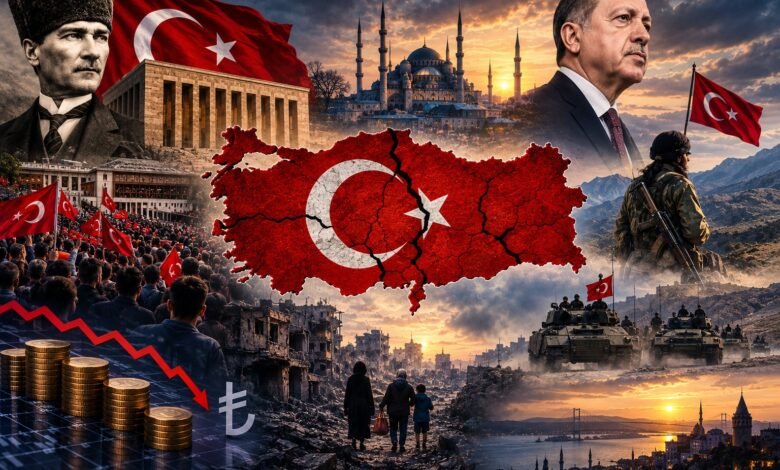
Among the crises confronting states in the Muslim world, none is more acute than the crisis facing
the Republic of Turkey, which appears to be on the verge of explosion. For several years, clear
signs have pointed to this impending crisis. The Turkish government repudiated the agreement
reached in late 2012 between Abdullah Öcalan, founder of the Kurdistan Workers’ Party (PKK),
and Hakan Fidan, then head of Turkey’s National Intelligence Organization and now its foreign
minister. In doing so, it abandoned its commitments to reconciliation and to resolving Turkey’s
Kurdish question through dialogue and negotiation.
The June 2015 parliamentary elections fundamentally reshaped the political landscape. The
Kurdish Peoples’ Democratic Party (HDP) surpassed the electoral threshold, winning 13.6 percent
of the vote and, for the first time in the Turkish Republic’s history, securing a parliamentary bloc
of eighty deputies. The Nationalist Movement Party (MHP) won the same number of seats,
denying the Justice and Development Party (AKP) the majority needed to govern alone.
In the wake of the elections, the AKP government launched a military campaign against the
Kurdistan Workers’ Party, turning parts of the Kurdish regions into battlefields. Turkish military
vehicles advanced through the streets as tanks patrolled urban neighborhoods. Clashes between
the Turkish army and PKK combatants coincided with airstrikes on the party’s camps in the
mountains of northern Iraq, while helicopter gunships targeted militant positions in the
mountainous terrain along both sides of the Turkish-Iraqi border.
The conflict intensified ahead of the November 2015 snap elections, in which the AKP won 49.6
percent of the vote, securing the majority it sought and the capacity to govern alone. By then,
however, many believed the Turkish government’s war could neither be halted nor reversed, but
would instead escalate and spread across all Kurdish provinces and regions of Turkey in its initial
phase.
The PKK was expected to launch a sweeping military offensive, ushering in a second phase in
which the conflict would spread across Turkey, including its provinces, and erupt into urban
warfare in major cities. It would then evolve into a Turkish-Kurdish war, inaugurating a new
chapter in the national struggle between the country’s two principal ethnic communities.
Part I 1- Historical Roots and Structural Contradictions