
“Mecca Joint Defence Agreement” Draws the Contours of a New Regional Defense Alliance Against Iran and Its Allies

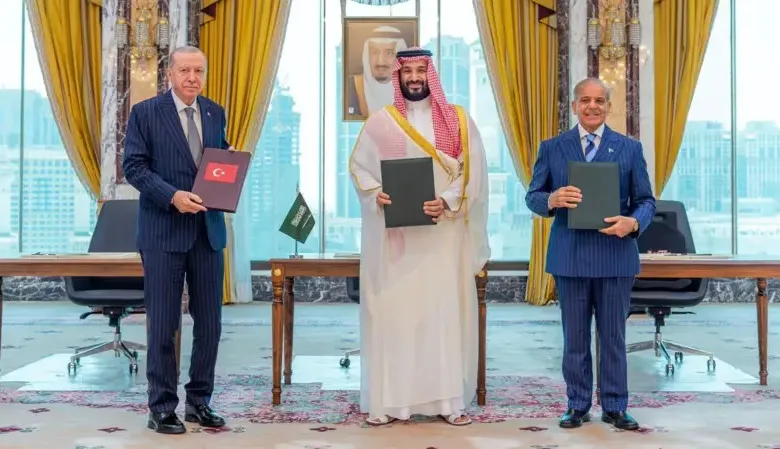
During the Mecca Summit, hosted by the Kingdom and attended by Saudi Crown Prince Muḥammad bin Salmān, Turkish President Recep Tayyip Erdoğan, and Pakistani Prime Minister Muḥammad Shehbaz Sharif, Saudi Arabia, Turkey, and Pakistan signed the Mecca Agreement for Mutual Defense. A joint statement from the summit states that the agreement seeks to strengthen collective deterrence against any aggression and declares that an armed attack on one of the three nations will be regarded as an attack on all. The agreement also encourages the development of comprehensive defense cooperation among the three countries.
This development confirms earlier predictions by Dr. Mohammad Walid Yousef, president of the International Center for Geopolitical and Economic Studies and Artificial Intelligence. He has consistently asserted that Turkey, Egypt, and the Damascus government will eventually join the Saudi–Pakistani alliance. He explained that although the alliance publicly targets Israel, its main strategic goal is to challenge Iranian influence and Tehran-aligned forces across the region.
Ebrāhīm Reżāʾī, a member of Iran’s Parliament’s National Security and Foreign Policy Committee, warned that “The Saudis should know that a paper agreement with Turkey and Pakistan does not bring them security, just as years of unilateral milking of the Americans did not bring them security.”[1]
In an article published on 22 September 2025 under the title “Israel: Between Conventional Iranian Missiles and the Saudi-Pakistani Nuclear Threat,” Dr. Yousef wrote that “While this alliance seems primarily designed to counter the threat from Israel to its member states, its deeper goal is to contain Iran and its allies—the Houthis in Yemen, the Popular Mobilization Forces in Iraq, and Hezbollah in Lebanon. Iran and its allies see this alliance with concern, as they have understood its true ambitions since 2017, when the so-called ‘Sunni NATO’ was envisioned as a tool to oppose Iran and its supporters.”
He further stated: “If the new Pakistani–Turkish–Azerbaijani alliance is connected, through Syria and Jordan, to Saudi Arabia, it will form a tightly closed geopolitical ring around Iran while simultaneously extending to the approaches of Israel.”
In part 4 of a series published on 16 April 2026 under the title “The Fourth Gulf War,” he argued “that The Gulf states are anticipated to pursue the creation of a Sunni Islamic military alliance, designated as the ‘Sunni NATO,’ with Qatar, Bahrain, Turkey, Egypt, Kuwait, Jordan, and Syria participating. This initiative is expected to facilitate the development of a Sunni Islamic security alliance, whereas the United Arab Emirates and the Sultanate of Oman will remain outside the coalition, owing to reasons particular to each nation and their involvement in other alliances.”
Dr. Yousef also noted that “this alliance aims to address the gaps and vulnerabilities exposed during the Fourth Gulf War, when the Gulf states were unable to strike Iran or retaliate effectively, and the United States failed to provide the full support they anticipated.”
[1] https://www.bbc.com/news/articles/c30418m4mj4o